
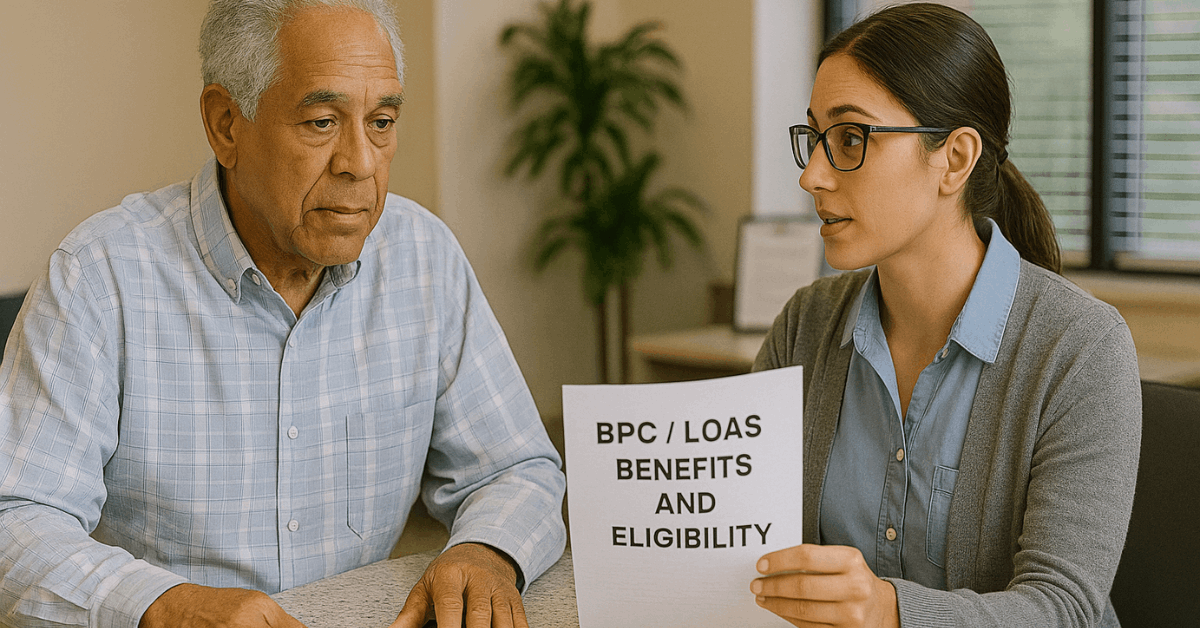
The Benefício de Prestação Continuada (BPC) is an important social protection in Brazil. Many people search for BPC/LOAS benefits and eligibility to know if they or their family members qualify.
This benefit provides a minimum income for elderly citizens and people with disabilities in vulnerable conditions. This article explains requirements, documents, application steps, and common issues.
Understanding BPC/LOAS
BPC and LOAS are often mentioned together, but each plays a different role. This section explains how the benefit works under the social assistance law.
BPC is guaranteed by the Organic Law of Social Assistance (LOAS), created to ensure dignity for vulnerable groups. The program is managed by INSS and provides a minimum wage to eligible applicants.
It is not a pension or retirement plan but a social right. Unlike other benefits, BPC does not require prior contributions to Social Security.

Eligibility Criteria
Eligibility rules are strict and must be followed. This section highlights who qualifies for the benefit.
Elderly Applicants
Applicants must be 65 years or older to qualify as elderly. Age is verified through official documents such as an ID or a birth certificate.
This group is entitled if they also meet the family income requirement. Meeting the age rule alone is not enough for approval.
People with Disabilities
Disabled applicants must prove a long-term condition. Disabilities may be physical, mental, intellectual, or sensory.
Medical evaluation confirms the extent of the limitation. The disability must significantly affect daily life and independence.
Income Requirement
The household income per person must not exceed one-quarter of the minimum wage. All household members’ earnings are included in the calculation.
Proof of income is mandatory and verified by INSS. Exceeding the limit usually results in denial.
Documentation Required
Documentation ensures transparency in the process. This section lists the main documents needed.
- Identification and CPF of the applicant and all family members.
- Proof of residence, such as utility bills.
- Medical reports and test results for disability cases.
- Income statements for each household member.
- Cadastro Único registration at CRAS.
Every document must be valid and updated. Missing or outdated papers are common reasons for delay.
Application Process
Applying requires following specific steps. This section shows the correct order.
Cadastro Único Registration
Applicants must first be registered in the Cadastro Único through CRAS. This step is mandatory for all applicants.
Registration verifies family income and living conditions. Without this record, no request can move forward.
Submitting the Request
After registration, the request must be made through the Meu INSS platform or directly at INSS branches. Applicants must provide all documents during this stage.
A receipt confirms the protocol of the request. Submissions with missing data are returned.
Interviews and Evaluations
INSS may require a personal interview and technical evaluation. This step checks financial vulnerability and verifies disability cases.
Trained professionals conduct the evaluation. Their report determines if requirements are met.
Final Review and Result
The process ends with a social assessment and final review. Analysts check all records against eligibility rules.
Approved cases are forwarded to payment scheduling. Results are usually issued within months after submission.
How Is The Benefit Paid?
After approval, payment is made monthly. This section shows how beneficiaries access funds. Payments are managed through Caixa Econômica Federal or Banco do Brasil.
Beneficiaries receive a card for withdrawals or can request a deposit into a bank account. The value corresponds to one minimum wage set by federal law. Payments do not include extras such as a 13th salary.
Key Differences Between BPC and Pensions
BPC and pensions are often confused. This section clarifies the differences.
Contribution Differences
BPC does not require contributions to social security, unlike pensions. This means applicants do not need a work history to qualify. It is based on social vulnerability rather than contributions.
Pensions, however, are linked to employment contributions. They generate long-term insurance rights for workers. BPC does not create such benefits.
Benefit and Transfer Rules
BPC does not generate inheritance or benefits for dependents. There is no 13th salary payment under this program. It is strictly limited to the monthly wage.
Pensions, by contrast, may include bonuses and transferable rights. If requirements change, the BPC may be suspended immediately. This shows its conditional nature compared to pensions.
Reevaluation and Renewal
Approval is not permanent. The Cadastro Único must be updated every two years. For people with disabilities, periodic medical evaluations are required.
Failure to attend reviews can result in suspension. Keeping documents and records updated avoids interruptions in payment.
Common Reasons for Denial
Many applications are denied on the first attempt. This section lists the main reasons.
- Family income is higher than the legal threshold.
- Incomplete or incorrect documentation.
- Failure to prove long-term disability.
- Outdated Cadastro Único information.
- Contradictory statements during evaluation.
Being aware of these reasons helps applicants prepare better.
Appeals and Legal Actions
Not all denials are final. This section shows alternatives for applicants. Appeals can be filed directly with INSS within the deadline.
Applicants may also seek help from CRAS staff or the Public Defender’s Office. If an administrative appeal is denied, judicial action is possible. Many applicants secure approval after going to court.
Recent Updates and Changes
BPC rules adapt over time. This section shows the latest changes. The digitalization of applications has simplified access through the Meu INSS platform.
Income rules are sometimes adjusted by new laws or government measures. Temporary measures were applied during the COVID-19 crisis to speed approvals.
Staying updated through official sources such as the Ministry of Citizenship and INSS news pages prevents misinformation and delays.
Frequently Asked Questions
Readers often have recurring doubts. This section answers them directly.
- Can BPC be combined with Bolsa Família? Yes, if income rules remain within limits.
- Is there a 13th salary? No, the benefit is limited to monthly payments.
- Can foreigners apply? Yes, if legally residing in Brazil with documentation.
- What if family income increases? The benefit may be suspended if the threshold is exceeded.
- How often is a review required? Usually, every two years, or earlier for disability cases.
Engaging Conclusion: Why Understanding BPC/LOAS Matters
The BPC ensures protection for the most vulnerable in Brazilian society. Many people seek BPC/LOAS benefits and eligibility information to know if they can secure this right.
Meeting the requirements and providing proper documentation is essential for approval. Understanding the rules helps families achieve stability and avoid denial.